The third chakra in the chakra system is solar plexus, also known as Manipura.
The sanskrit word mani means ‘jewel’ and pura means ‘city’. Therefore, manipura means ‘city of jewels’. In the Tibetan tradition, this chakra is known as mani padma, which means ‘jewelled lotus’.
This is the center of energy, willpower and vitality, the element of this chakra is fire and it’s often compared to the dazzling and radiant sun, just like sun radiates life to all planets and is the center of the solar system, manipura is the center of a very complex network of subtle energy and distributes pranic energy throughout the body fueling both physical and subtle energy systems.
This chakra is closely linked with personal power, ambition and leadership skills. A well balanced manipura fuels motivation, ambition and vitality.
Overview
Names: Manipura, Manipurak, Nabhi, Solar Plexus
Meaning: City of Jewels or Gems
Location: The navel region
Ruling Planet: Sun (solar, masculine)
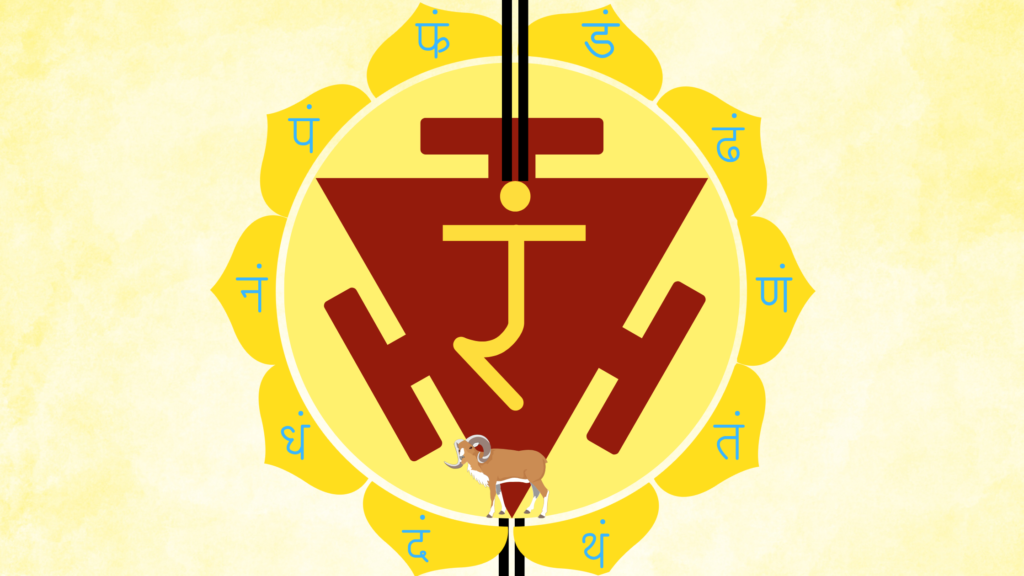
Symbol: A yellow ten-petaled lotus with a downward-pointing triangle symbolizing transformation and power.
Element/Tattva: Fire
Element Color: Red like fire
Element Shape (Yantra): Triangle (downward-pointing)
Number of Petals: Ten-petalled bright yellow lotus
Beeja Mantra/Seed sound: Ram
Frequency: 528 Hz
Seed Sound Carrier: Ram
Seed sounds of the petals: ḍaṁ, ḍhaṁ, ṇaṁ, taṁ, thaṁ, daṁ, dhaṁ, naṁ, paṁ, and phaṁ
Aspects: Ego, form
Associated Gland: Pancreas
Associated Body Parts: Stomach, liver, gallbladder, and small intestine
Sense Organ: Eyes
Predominant sense: Sight
Associated auric layer: The third layer the Mental body
Kosha: Pranamaya kosha
Air/Vayu prana: Samana
Plane: Celestial plane
Clair: Claircognizance
Location
The trigger point for this chakra is in the middle of the spine, directly behind the navel. You can feel it by using finger pressure. Put the finger of one hand in the front part of the body and the other at the backside, making sure both finger points are in the same line.
Practice to feel
This practice helps to locate manipura chakra’s location.
- Sit in a comfortable position and relax.
- Perform uddiyana bandha.
- Remain aware of the navel.
- Practice this for a few minutes and then stop the practice.
- Now simply focus on the sensations around the navel region.
- After a few minutes direct your attention to the chakra trigger point.
- Do this for a few minutes and feel your chakra center, you can stimulate with your fingers too, as described in ‘location’
- Do this practice however long you want to.
Symbol
Manipura chakra is traditionally represented by a lotus flower with ten bright yellow petals. On each petal is a letter: pham, dam, dham, nam, tam, tham, dam, dham, nam, pam written in blue color.
The ten petals represent ten important mental modifications:
Pham: Spiritual ignorance
Dam: Thirst
Dham: Jealousy
Nam: Treachery
Tam: Shame
Tham: Fear
Dam: Disgust
Dham: Delusion
Nam: Foolishness
Pam: Sadness
In the middle of the chakra lies an inverted triangle with swastika in T shape at all its side, the triangle is fiery red in color and shines brightly in the triangle lies the seed mantra RAM, at its bindu reside deva Rudra and the devi Lakini.
Behavioral Characteristics
OVERACTIVE
- Controlling and domineering behavior, need for power over others.
- Excessive competitiveness and aggression, constantly proving yourself.
- Workaholism and perfectionism, never feeling satisfied with accomplishments.
- Anger issues and irritability, short temper, frustration, impatience.
- Judgmental or critical of others, constantly analyzing and finding faults.
- Ego-driven decisions pride, arrogance, unwillingness to admit mistakes.
- Digestive issues like acid reflux, ulcers, excessive heat in the body.
- Hyperactivity and restlessness, feeling wired, unable to relax.
UNDERACTIVE
- Low self-esteem and self-doubt, lack of confidence, seeking validation.
- Fear of failure or rejection, avoiding risks, procrastination.
- Lack of motivation and willpower, feeling stuck, unable to take action.
- Indecisiveness and difficulty making choices
- Easily influenced by others, lack of personal boundaries, people-pleasing.
- Passive or submissive behavior, fear of asserting yourself.
- Chronic fatigue and low energy levels.
- Poor digestion and sluggish metabolism, bloating, constipation, low appetite.
BALANCED
- Strong self-confidence and inner strength.
- A good sense of personal power (not controlling or passive).
- Clear decision-making and trust in yourself.
- Balanced ambition and motivation.
- Leadership qualities and ability to take initiative.
- Strong digestion and steady energy levels.
- Emotional resilience and ability to handle challenges.
- Comfortable setting boundaries and saying ‘no’ when needed.
Practices to balance this chakra
There are various ways to stimulate and balance a chakra, some of them are meditating on the chakra point, yoga exercises, consuming foods that affect organs related to that chakra, sound healing, aromatherapy etc.
Balancing a chakra involves working directly with the chakra point, and body parts associated with it.
Before we move on to the techniques, here are body parts, organs and glands associated with this chakra:
Associated Organs & Body Parts
- Stomach
- Liver
- Pancreas
- Small intestine
- Gallbladder
- Digestive system
Associated Gland
- Pancreas: Regulates digestion and blood sugar levels through insulin production.
Yoga Exercises
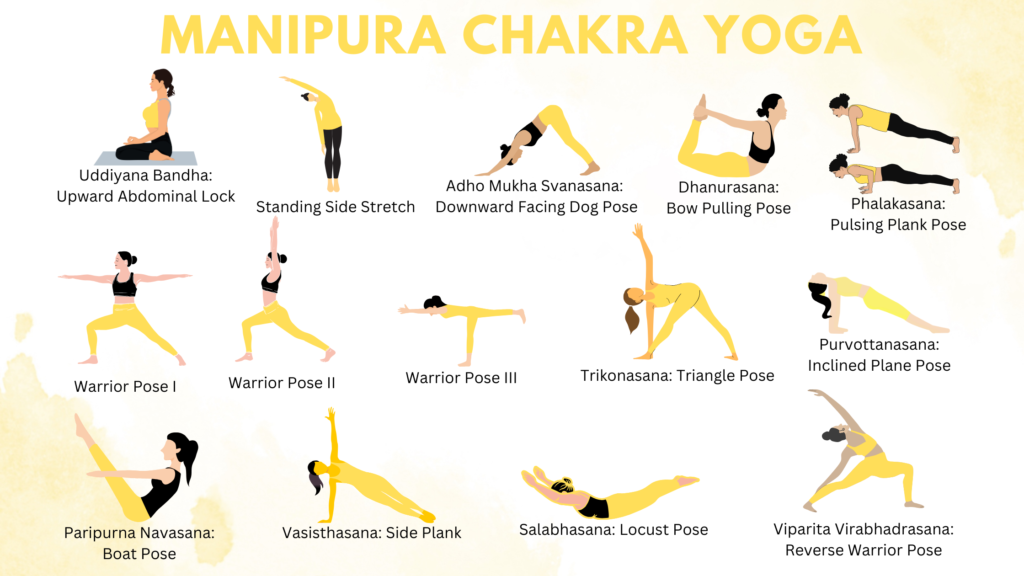
These yoga exercises involve mudras, asanas, pranayama and bandhas that directly work with this chakra. With intention, focus and consistency you are bound to see good results.
Pranayama
- Kapalabhati (Skull Shining Breath).
- Agnisara Kriya (Fire Breath).
Asana
- Uddiyana Bandha: Upward Abdominal Lock
- Standing Side Stretch
- Adho Mukha Svanasana: Downward Facing Dog
- Virabhadrasana: Warrior Poses I, II, and III
- Viparita Virabhadrasana: Reverse Warrior Pose
- Trikonasana: Triangle Pose
- Phalakasana: Plank & Pulsing Plank Pose
- Paripurna Navasana: Boat Pose
- Desk Pose
- Purvottanasana: Inclined Plane Pose
- Vasisthasana: Side Plank
- Salabhasana: Locust Pose
- Dhanurasana: Bow Pulling Pose
Mudra
- Surya Mudra – Touch ring finger to thumb
Bandha
- Uddiyana Bandha (Abdominal Lock) – Activates core energy.
Crystals
Crystals are easy to use, every crystal has its own unique frequency just like our energy centers.
There are many ways to use crystals like programming them with intention and repetition, wearing them or keeping them close, meditating on them, putting them on chakra points etc.
You don’t need to have them all, just go for the ones you feel drawn to.
- Citrine – Is yellow in color with translucent appearance, used for success, confidence and manifestation.
- Yellow Jasper – Is opaque and mustard yellow in color, used for protection, strength and willpower.
- Pyrite – Looks golden metallic, used for abundance, prosperity and motivation.
- Golden Tiger’s Eye – Deep yellow-gold in color, used for courage, clarity and determination.
- Amber – Golden-orange in color, has a warm texture, used for emotional healing and vitality.
Aromatherapy
Every chakra is associated with a certain part of the brain, aromatherapy influences and stimulates certain parts of the brain which affects the nervous system and body chemistry.
It’s very powerful, you surely have had experience how foul smells make you feel awful and there are fragrances that uplift mood or create a certain type of environment.
You can use them in multiple ways like using essential oil diffuser for your space, direct application on the chakra point, in baths, direct inhalation or massaging with them.
- Lemon – Bright fresh citrusy scent, helps with mental clarity, motivation and confidence.
- Ginger – Spicy warm and slightly woody scent, helps with strength, willpower and personal energy.
- Peppermint – Have a cool minty sharp scent, make you feel refreshed, helps with focus and energetic balance.
- Black Pepper – Have spicy warm and slightly woody scent, helps with courage, inner strength and action.
- Chamomile – Have a soft herbal and slightly sweet scent, it helps with emotional balance and self-acceptance.
Food
Food is a really essential part of our lives, it can act as medicine or poison depending on how you use it.
Every chakra is associated with a certain element, gland, body parts and organs, the food mentioned are the ones that affect these parts of the body, not to mention every food has its own vibration, it’s all energy.
- Yellow Fruits & Vegetables – Bananas, pineapples, lemons, yellow peppers, corn, turmeric
- Complex Carbohydrates & Fiber – Oats, brown rice, millet, lentils, chickpeas
- Metabolism-Boosting Foods – Ginger, cinnamon, cayenne pepper, black pepper
- Healthy Proteins – Sunflower seeds, almonds, tofu, quinoa
Sound Healing
Sound healing is yet another powerful way to work with our energy centers. Sound vibrations affect our brains and body, every organ and energy center in the body has a specific frequency. Using right tuning instruments you can bring balance to any organ or energy center.
Sound healing is used for many purposes, to affect the brain, organs, healing disease, inducing different states of consciousness, you can either use instruments or chant mantra associated with the energy center.
- Bija Mantra: “RAM”
- Healing Frequency: 528 Hz, restores self-esteem and personal power.
- Instruments: Bells, chimes, gongs, fire crackling sounds
Color Healing
Color healing works in a similar way, every color has its own frequency and wavelength, you can wear the color, focus on it, breathe it in during meditation, visualize it in the focused area etc.
- Color: Yellow