
The second chakra in the chakra system is sacral chakra, also known as Svadhishthana.
The Sanskrit word swa means ‘one’s own’ and adhisthana means ‘dwelling place’, ‘residence’, which translates to ‘one’s own abode’.
Every experience you have, gets stored in the subconscious mind whether you recall it or not, it plays a part in determining your daily behaviour, attitudes and reactions.
Swadhisthana is the storehouse of mental impressions and is associated with the unconscious mind. All our past karma, past lives and experiences that are unconscious can be symbolized by this chakra.
Swadhisthana is directly associated with the throat chakra, opening it helps to stimulate throat chakra.
Overview
Names: Svadhishthana, Adhishthan, Sacral chakra
Meaning: Dwelling Place of the Self
Location: Lower abdomen between navel and the genitals.
Ruling Planet: Mercury (lunar, feminine)
Symbol: A silver crescent, symbolizing the moon, inside a white circle serving as water.
Element/Tattva: Water
Element Color: Transparent, white, light blue
Element Shape (Yantra): Circle, like a drop of water
Number of Petals: Six-petalled vermilion lotus
Beeja Mantra/Seed sound: Vam
Frequency: 417 Hz
Seed Sound Carrier: Crocodile (makara)
Seed sounds of the petals: Ban, Bhan, Man, Yan, Ran, Lan
Aspects: Creativity, sensuality
Associated Gland: Gonads
Associated Body Parts: Reproductive organs, bladder, pelvis
Sense Organ: Tongue
Predominant sense: Taste
Associated auric layer: The second layer Emotional body
Kosha: Pranamaya kosha
Air/Vayu prana: Apana
Plane: Astral plane
Clair: Clairempathy (sensing of other’s feelings)
Location
The coccyx bone is the trigger point for swadhisthana, if you move your hands down the spine at the base you’ll feel something bumpy, that’s the trigger point of this chakra.
Practice to feel it
Trigger point for a chakra is the point where it is located along the spine, trigger point is different from the chakra region, the chakra region the area occupied by the chakra rotation.
This practice will help you to feel the trigger point of this chakra.
- Sit in a comfortable position and relax.
- Close your eyes and focus on mooladhara chakra
- Now try to feel the position of swadhisthana at the trigger point
- Perform ashwini mudra with rapid contractions.
- Bring your focus to the base of spine and feel the sensations
- Do this again but this time focus on the region directly in front of the coccyx bone.
Symbol
Swadhisthana chakra is traditionally represented by a lotus flower with six vermilion or orange-red petals. On each petal there is a letter: bam, bham, mam, yam, ram, and lam, the color of the letter is the same as lightning.
The six petals represent six important mental modifications:
Bam: Affection
Bham: Suspicion
Mam: Disdain
Yam: Delusion
Ram: Destructiveness
Lam: Pitilessness
The element of this chakra is water, symbolized by a white crescent moon within the pericarp of the lotus.
The crescent moon is formed by two circles which are separated by the white crocodile in the crescent moon.
The crocodile carries the seed sound VAM which is silver white in color, within the bindu of the mantra reside the deva Vishnu and the devi Rakini.
Behavioral Characteristics
OVERACTIVE
- Emotional instability and mood swings, overly dramatic, hypersensitive.
- Overindulgence in pleasure like addictions to food, sex or pleasure-seeking activities.
- Lack of boundaries, people-pleasing, dependency on others for happiness.
- Obsessive behavior and attachment, clingy relationships, intense jealousy.
- Excessive sexual desire or promiscuity.
- Over-identification with emotions, easily overwhelmed, unable to detach.
- Manipulative tendencies, using charm or sexuality to get what you want.
- Reproductive and urinary issues, hormonal imbalances, excessive sexual energy.
UNDERACTIVE
- Lack of passion and creativity, feeling uninspired, blocked creativity.
- Emotional numbness or repression, disconnect from feelings, inability to express emotions.
- Fear of intimacy and commitment, avoiding deep connections, fear of vulnerability.
- Low libido and lack of sexual desire.
- Guilt and shame around pleasure or sexuality.
- Rigidity and difficulty enjoying life, strict self-discipline, inability to relax.
- Chronic fatigue and low energy.
- Reproductive issues and menstrual irregularities.
BALANCED
- Emotional balance and healthy self-expression.
- Passion and enthusiasm for life.
- Creativity flows effortlessly.
- Healthy and fulfilling relationships.
- Comfortable with intimacy and pleasure.
- Good sense of boundaries and self-respect.
- Balanced sexual energy, not suppressed or excessive.
- Joy in movement and fluidity in life.
Practices to balance this chakra
There are various ways to stimulate and balance a chakra, some of them are meditating on the chakra point, yoga exercises, consuming foods that affect organs related to that chakra, sound healing, aromatherapy etc.
Balancing a chakra involves working directly with the chakra point, and body parts associated with it.
Before we move on to the techniques, here are body parts, organs and glands associated with this chakra:
Associated Organs & Body Parts
- Reproductive organs (ovaries, testes)
- Kidneys
- Bladder
- Lower back
- Pelvis
- Hips
Associated Gland
- Gonads (Ovaries/Testes): Responsible for hormones regulating sexual function and reproduction.
Yoga Exercises
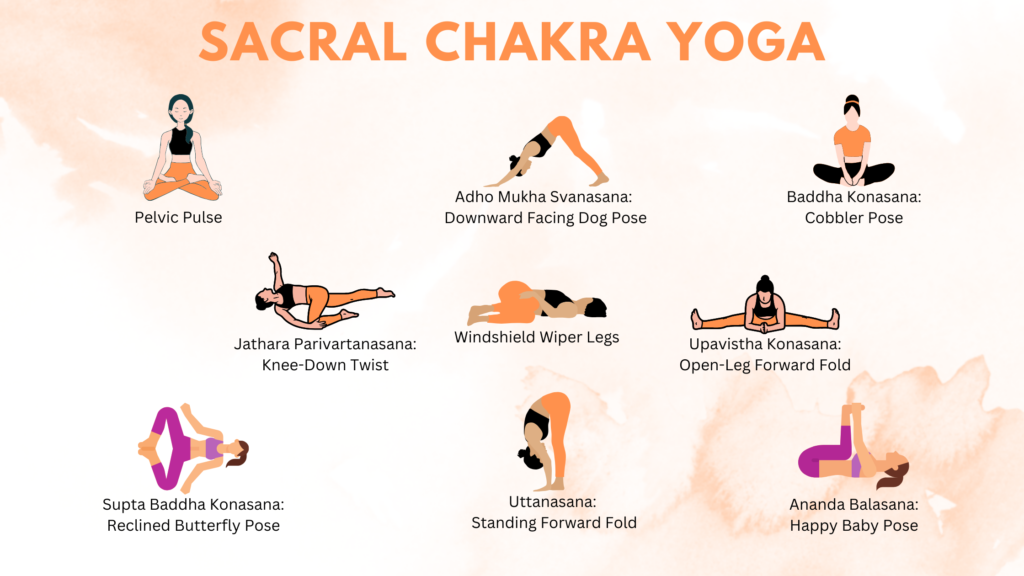
These yoga exercises involve mudras, asanas, pranayama and bandhas that directly work with this chakra. With intention, focus and consistency you are bound to see good results.
Pranayama
- Nadi Shodhana (Alternate Nostril Breathing)
- Kapalabhati (Skull Shining Breath)
Asana
- Pelvic Pulses
- Pelvic Breath
- Windshield Wiper Legs
- Supta Baddha Konasana: Reclined Bound Angle or Butterfly Pose
- Ananda Balasana: Happy Baby Pose
- Jathara Parivartanasana: Knee-Down Twist
- Baddha Konasana: Bound Angle or Cobbler Pose
- Upavistha Konasana: Open-Leg Forward Fold
- Uttanasana: Standing Forward Fold
- Adho Mukha Svanasana: Downward Facing Dog Pose
- Supta Baddha Konasana: Savasana with Open Legs
Mudra
- Varuna Mudra – Touch little finger to thumb.
- Ashwini Mudra (horse gesture)
- Vajroli Mudra (thunderbolt attitude) – for men
- Sahajoli Mudra (spontaneous psychic attitude) – for women
Crystals
Crystals are easy to use, every crystal has its own unique frequency just like our energy centers.
There are many ways to use crystals like programming them with intention and repetition, wearing them or keeping them close, meditating on them, putting them on chakra points etc.
You don’t need to have them all, just go for the ones you feel drawn to.
- Carnelian – Is bright orange translucent, helps with motivation, confidence and creativity.
- Orange Calcite – Is soft orange semi-opaque, helps with emotional healing, joy and vitality.
- Tiger’s Eye – Brown with golden streaks, used for strength, confidence, and inner power.
- Sunstone – Is Orange-red and shimmery, helps with happiness, optimism, and personal power.
- Moonstone – Looks white with blue shimmer, enhances feminine energy, intuition.
Aromatherapy
Every chakra is associated with a certain part of the brain, aromatherapy influences and stimulates certain parts of the brain which affects the nervous system and body chemistry.
It’s very powerful, you surely have had experience how foul smells make you feel awful and there are fragrances that uplift mood or create a certain type of environment.
You can use them in multiple ways like using essential oil diffuser for your space, direct application on the chakra point, in baths, direct inhalation or massaging with them.
- Sweet Orange – Have a fresh citrusy uplifting scent, helps with feelings of joy, sensuality.
- Ylang Ylang – Have exotic floral sweet scent, it helps with passion, intimacy and emotional balance.
- Sandalwood – Have warm creamy and woody type of scent, it helps with sensory awakening, relaxation and connection.
- Jasmine – Have a rich sweet floral scent that enhances creativity, self-love and pleasure.
- Bergamot – Smells Citrusy, slightly spicy and fresh, helps with uplifting mood, confidence and clarity.
Food
Food is a really essential part of our lives, it can act as medicine or poison depending on how you use it.
Every chakra is associated with a certain element, gland, body parts and organs, the food mentioned are the ones that affect these parts of the body, not to mention every food has its own vibration, it’s all energy.
- Orange Fruits & Vegetables – Oranges, mangoes, papayas, pumpkins, sweet potatoes, carrots
- Healthy Fats & Dairy – Coconut, almonds, walnuts, avocados, yogurt
- Seeds – Flax Seeds, sesame seeds, chia seeds
- Hydrating Foods – Herbal teas, coconut water, cucumber, melons
Sound Healing
Sound healing is yet another powerful way to work with our energy centers. Sound vibrations affect our brains and body, every organ and energy center in the body has a specific frequency. Using right tuning instruments you can bring balance to any organ or energy center.
Sound healing is used for many purposes, to affect the brain, organs, healing disease, inducing different states of consciousness, you can either use instruments or chant mantra associated with the energy center.
- Bija Mantra: “VAM”
- Healing Frequency: 417 Hz removes negativity, boosts creativity.
- Instruments: Water sounds, flutes, singing bowls in D-note.
Color Healing
Color healing works in a similar way, every color has its own frequency and wavelength, you can wear the color, focus on it, breathe it in during meditation, visualize it in the focused area etc.
- Color: Orange